


Memory is the foundation on which every relationship is built. A strong connection between two entities is really a living, evolving bond rooted in shared memory.
If you want to build lasting relationships with your audience, you need to be remembered.
That’s where storytelling becomes indispensable. When you hear a story, you retain it far better than if you’re presented with the same information as plain facts. Stories activate multiple regions of your brain at once, creating more “hooks” for the memory to latch onto, so to speak.
After all, we all remember what we feel far better than what we’re merely told.
That’s why storytelling is everywhere in marketing. And the data backs it up:
- 55% of customers are more likely to recall a brand story than a rundown of facts.
- 92% of business leaders believe storytelling is an effective way to
The same principle applies to email marketing. In fact, with micro-stories on the rise, email’s short format is now even more suited to storytelling. That’s what we’ll explore today. Let’s begin.

How to Do Storytelling in Emails: 5 Expert Tips
1. The Rule of 3
Before you set out to write a story, you’ll need the three things: Character, intention, and tension.
- Character: Can be anyone, real or fictional. It could be your customers, someone on your team, celebrities, cartoon characters, etc.
- Intention: Determine what the character is trying to say through the story.
- Tension: Pique your reader’s curiosity by anchoring the narrative in a conflict, which can be fictional, humorous, or something real and urgent.
Once you have these three things locked, the rest is finding the right words and creating a stellar piece of conversion-focused email copy.
2. Make Your Stories Relatable
Unless you’re sending emails to absolute strangers, you don’t have to try too hard to make your stories relatable. In fact, trying too hard gives itself away. Remember to:
- Match the character’s intention to the primary aspirations of your reader. So for example, if you’re a wellness brand, you could do a story on weight loss.
- Draw attention to the transformation the character undergoes. You can frame it around the product or service you’re trying to sell.
- Use the tension to demonstrate the transformation.
The point is to enable readers to see themselves in the story you’re telling.
3. Nail the Hook
When it comes to storytelling, the most important part is the hook. In email particularly, it’s the hook that will decide whether or not the viewer will open your message:
- Ace the subject line since that’s the first thing visible. For stories, the best way to do it is to begin in medias res. You can do it by pulling intriguing phrases from the story.
- After the subject line and preview text, your next hook should appear in the first thing your reader sees when they open the email i.e. the hero space.
Make sure the hook is neither too descriptive nor too absurd. It should intrigue the reader, but not bewilder or appall them. Remember, the hook is for the email, not email for the hook.
4. Nail the Pivot
The trickiest part comes now. How do you transition from your story to marketing proper? There are various ways of pulling it off. But here are a few tricks you can try:
- The temptation would be to force a parallel with your service or product right away. Resist it. In fact, don’t bother about it. Complete your story first.
- Once you’re done with the story, make your marketing point.
- Add a couple of connecting sentences to bridge the transition to the sales message.
Importantly, make sure the transition is natural.
5. Prioritize Real, Lived Stories
This isn’t to discourage fictional narratives, but avoid stories that feel engineered solely to support your message. Readers can sense when a story exists only to “make a point.”
As far as telling real stories are concerned, a lot depends on how you source them:
- Practice noticing everyday moments that could become stories. Reference your collection when you’re planning your next email.
- Share both professional and personal stories. People want to know who you are.
- Once in a while, talk about your vulnerabilities, failures, and embarrassments. Not every email needs to be about tips or strategies. Keep it human.
- Random, funny stories work if you can connect them properly to your message.
(Speaking of fictional examples, check out BBC’s interactive storytelling email.)
So much for theories. Let’s look at how this plays out in the real world.
| Types of Storytelling Emails that Convert | ||
|---|---|---|
| Type | Focus | Content Flow |
| Origin story | Brand history | Share the founder’s journey and “why” |
| Customer success | Social proof | Problem → Solution → Transformation |
| Behind-the-scenes | Human connection | Personal stories and faces behind the brand |
| Educational | Value and authority | Lesson learned → Universal application |
| Product journey | Transparency | Challenges → Development → Breakthrough |
7 Memorable Email Storytelling Examples
1. Shakti
Subject line: The spikey mat that put us on the map


This email excels at storytelling because it transforms a simple product into a symbol of identity and evolution. It leads with legacy. By framing the mat as “the one that put us on the map,” the brand establishes its heritage and authority.
More importantly, the story reinforces positioning. The founder’s journey, the philosophy behind the design, and the refinement over time all serve one purpose: to justify why this brand, not just this product, matters. Innovation is presented as continuity, not change, which strengthens trust. And by the time the CTA appears, the reader is really buying into a movement.
2. dbrand
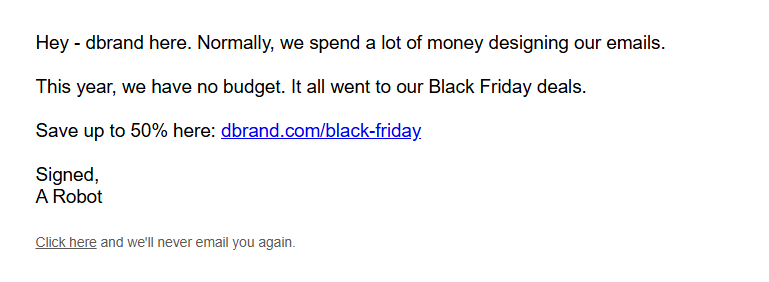
Subject line: we’re broke 📉

Source: Inbox
Dbrand is one of our favorite brands when it comes to email marketing. They’re a great bunch of storytellers. This email is just one example of their genius.
The lack of visual polish becomes the hook, so to speak. The email is raw, self-aware, and also slightly irreverent. It leans into radical transparency as a persuasion tactic. In a sea of loud, image-heavy promotions, this email stands out because it refuses to compete on those terms.
And did we say, the best part about this email is the subject (line).
3. 1906
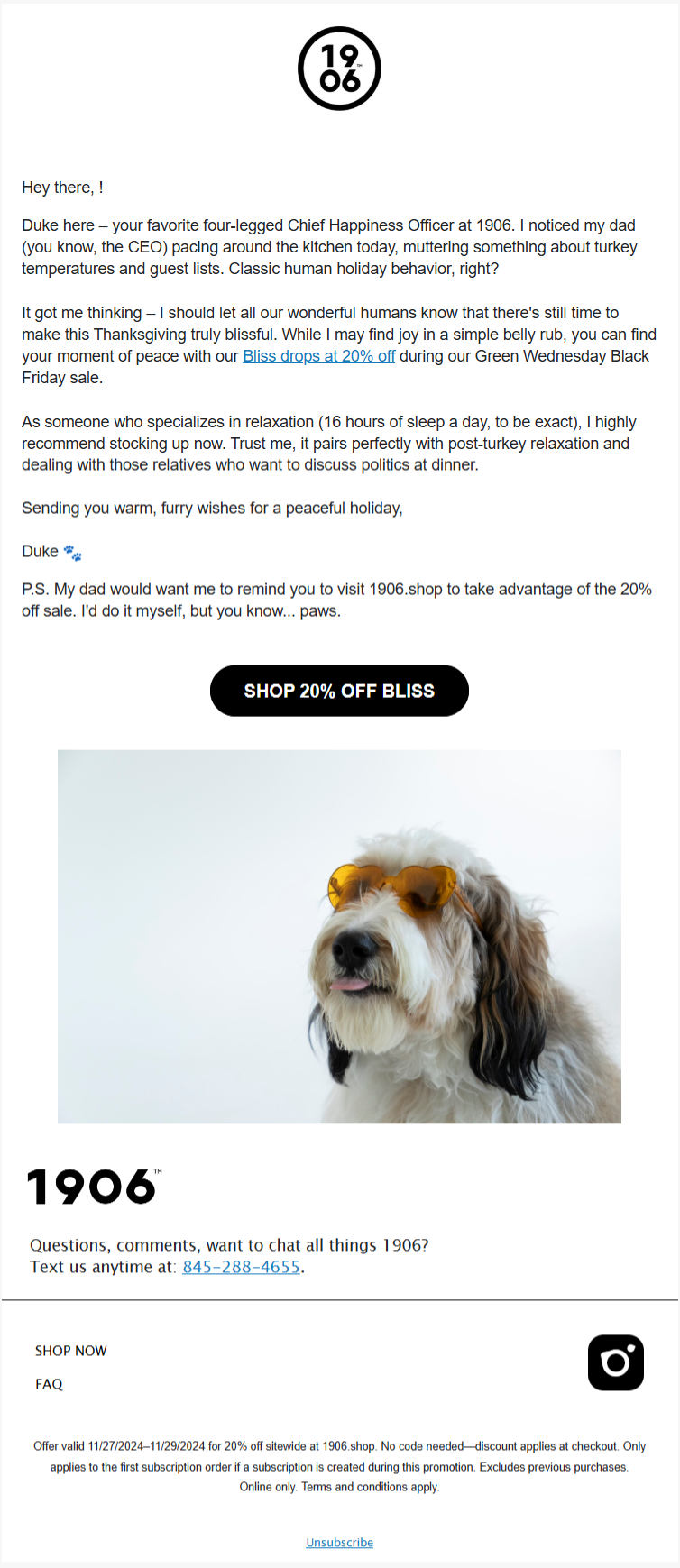
Subejct line: A Thanksgiving Tail from Duke 🐾

Source: Inbox
By writing from the dog’s perspective, 1906 transforms their standard holiday promotion into character-driven storytelling. Through Duke’s playful commentary on “classic human holiday behavior,” the brand connects the product to a relatable seasonal tension: Thanksgiving stress.
The humor, warmth, and light absurdity reinforce the idea of calm and relaxation. The dog recommending “stocking up” because he sleeps 16 hours a day is funny, but it subtly anchors the core promise: rest and peace.
Perhaps most importantly, the email is balanced.
The personality grabs your attention, the holiday context creates urgency (limited-time 20% off), and the clean layout ensures the offer is still clear. It entertains without obscuring the sale.
4. Bombas
Subject line: Oh Brother, Something’s Coming 🥜

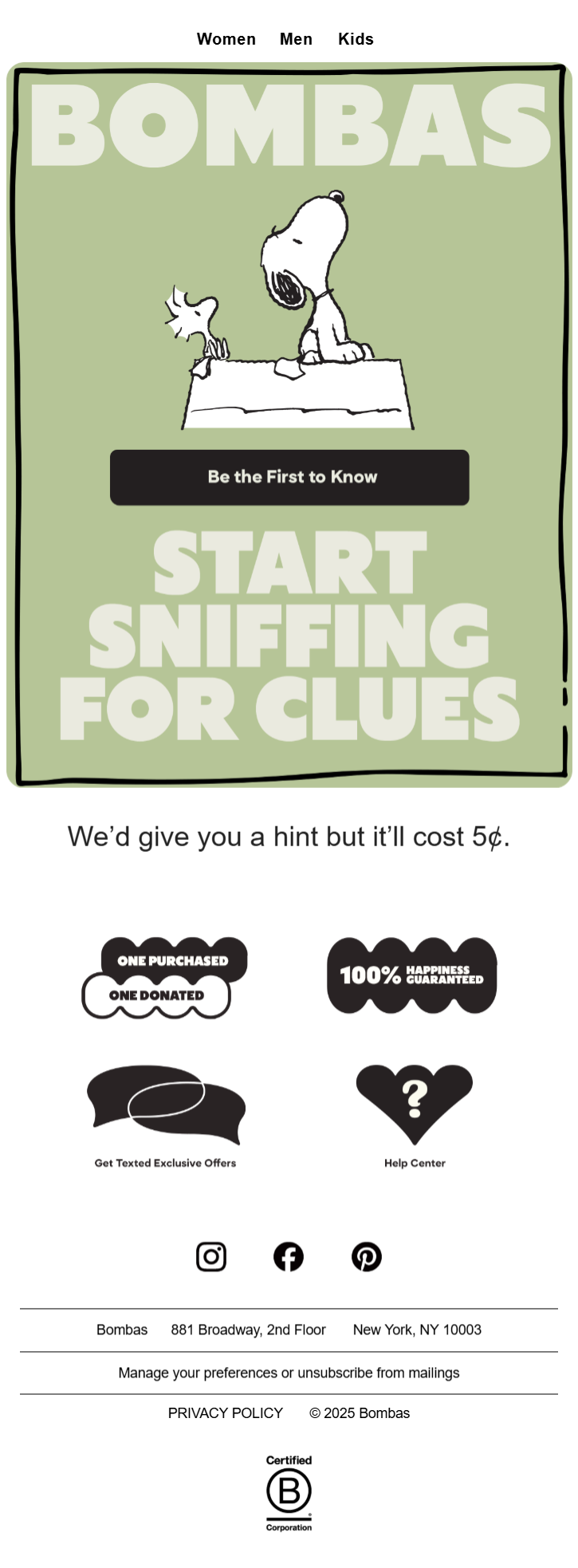
Source: Inbox
Bombas relies on Snoopy to launch their mystery product. “Sniffing for clues” is well-written. The one-liner below the hero image is also nicely done.
Importantly, the mystery is anchored in brand values. Even while teasing something new, the email reiterates core trust signals like “One Purchased, One Donated” and the happiness guarantee. That balance ensures the intrigue does not overshadow credibility. The result is a campaign that builds anticipation while strengthening brand recall and emotional affinity.
5. Fetching Fields
Subject line: Fetching With Amanda & Henry

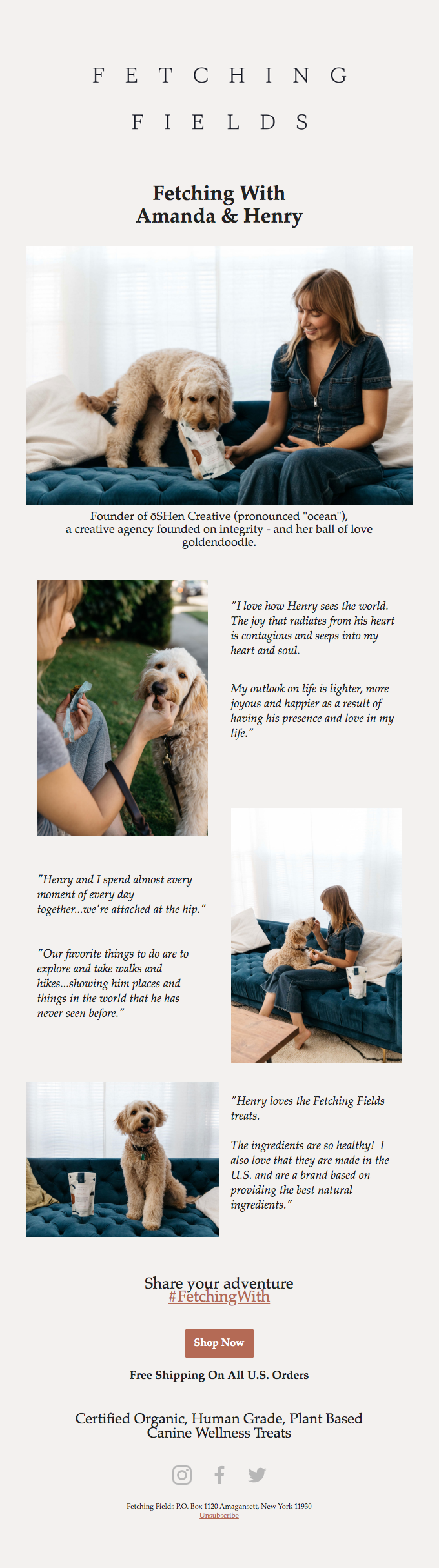
This email uses storytelling by centering the narrative on a real relationship — Amanda and her dog, Henry. The emotional bond becomes the entry point. The email tells a story about companionship, daily rituals, and shared adventures. The quotes function as first-person narration, making the story feel intimate and authentic. Readers are invited into small, relatable moments which naturally create context for the product.
Importantly, the product appears as part of the lifestyle, not the focus of it. The treats are woven into Henry’s world, reinforcing that they support the relationship. The result is a soft-sell story where emotion drives interest and the product simply fits into the narrative.
6. Maison d’Etto
Subject line: The Language of the Unspoken

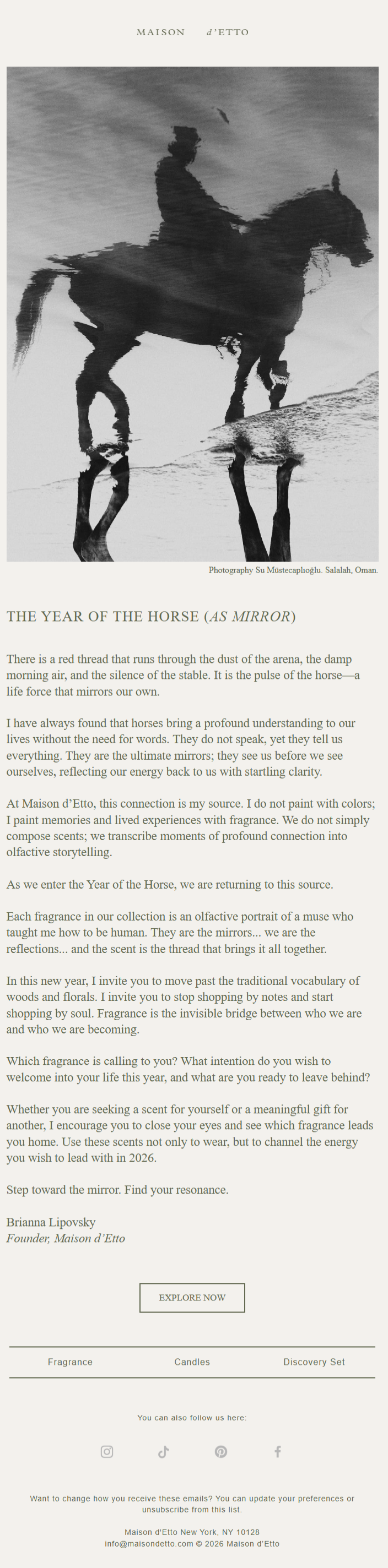
This email uses storytelling in a poetic, symbolic way. The horse becomes a metaphor and the narrative unfolds through reflection. There is no product push at the start; instead, the reader is invited into a mood, a philosophy, and a way of seeing.
The founder’s voice anchors the piece in personal meaning, turning fragrance into memory, identity, and transformation. The copy frames scent as an emotional bridge between who we are and who we are becoming. The story positions the brand as artistic and soulful.
The purchase is framed as a personal ritual. The storytelling elevates fragrance from product to experience, and from experience to self-discovery.
7. Carnivore Snax
Subject line: It’s happening… it’s finally happening! 👀Subject line: we’re broke 📉


Source: Inbox
This email uses a kind of immersive storytelling to turn a membership program into what feels like a cinematic initiation. It opens in thriller mode. The readers are led into an experience.
The “family” metaphor is doing heavy lifting. It reframes a paid membership as belonging, loyalty, and protection. Lines like “The Hunt has your back” shift the value proposition from discounts to security and identity. This taps into tribal psychology. The sequencing is deliberate. First: atmosphere. Second: belonging. Third: vow language. Only then do the tangible benefits appear. By the time readers see wagyu, cashback, and referrals, they’ve already emotionally opted in.
Overall, Carnivore Snax uses narrative immersion, tribal identity, and ritual language to transform a subscription into a status-driven community. That’s why it works.
Have A Story to Tell through Email? Get It Designed & Coded by Email Mavlers!
If there’s one common thread across all these examples, it’s this: the sale never comes first.
The story does.
The brands we looked at begin with identity, emotion, tension, belonging, curiosity, or reflection. Only after the reader is invested do they introduce the offer.
When done well, storytelling in email:
- Makes your brand recognizable beyond logos and colors
- Builds emotional equity over time
- Turns products into symbols
- Turns subscriptions into communities
- Turns offers into invitations
If you have a story to tell through email, we can help!Whether it’s a minimalist teaser, a cinematic launch, or a poetic brand manifesto, we’ll make sure your story looks beautiful and renders perfectly across devices. Let’s get started!